
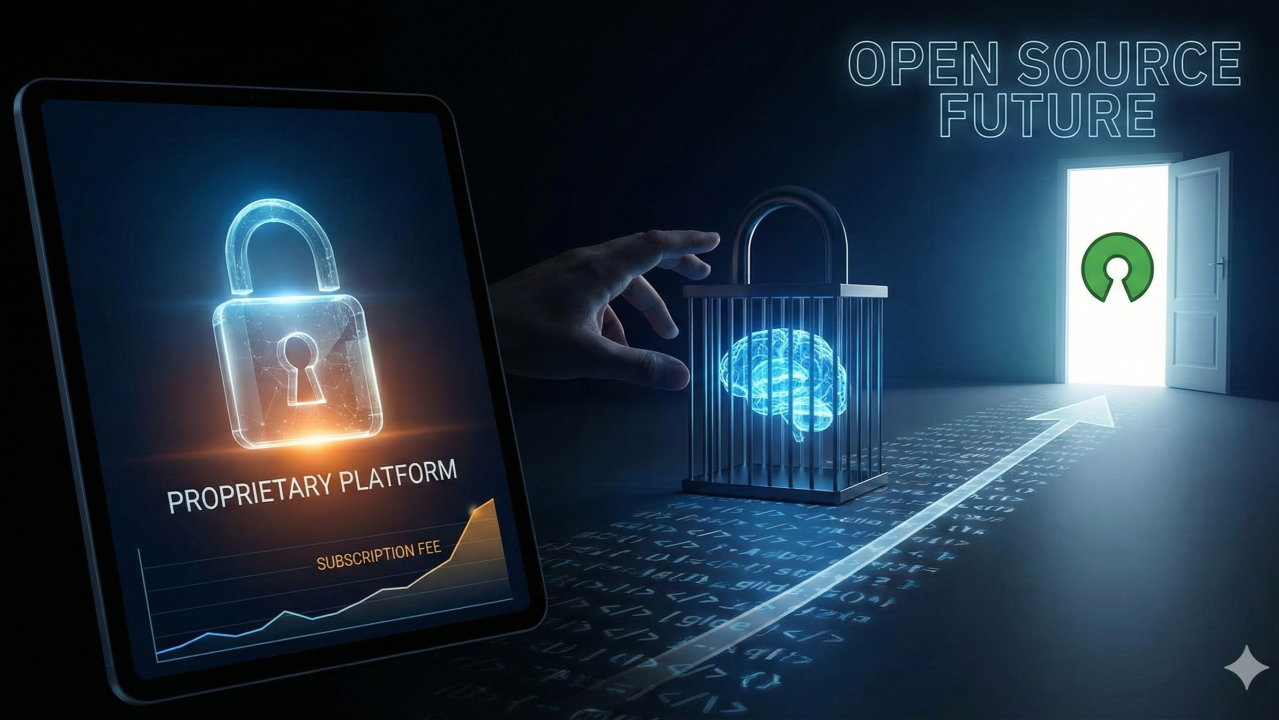
For years, significant research firms have championed the rise of" the citizen developer," urging CIOs to adopt proprietary low-code platforms to bridge the talent gap. They promised speed, simplicity, and agility. But they missed the tectonic shift that has rendered their analysis obsolete: The AI Revolution.
If your company is currently building on a proprietary low-code platform, you aren't just building applications; you are building a technical debt trap. The catalyst for this realization is AI—and the hard truth that AI is fundamentally built to work with code, not vendors' niche metadata.
The Metadata Blind Spot
Traditional low-code platforms operate on "metadata"—a series of proprietary instructions executed by a "black box" runtime engine. To the human eye, a drag-and-drop interface looks easy. To an AI, however, that metadata is a foreign, low-context language with a statistically insignificant training set.
Large Language Models (LLMs) like GPT-4, Claude, and Llama are trained on billions of lines of standard code—JavaScript, Python, and Java. They understand the logic, the edge cases, and the structural nuances of these languages with terrifying precision. When you ask an AI to debug or optimize standard code, it draws from a global ocean of knowledge.
When you ask an AI to help you within a proprietary low-code environment, it is effectively "AI-blind." It cannot see inside the vendor's runtime. It cannot predict how a specific metadata flag will interact with a hidden engine. In a world where AI is the primary driver of productivity, choosing a metadata-driven platform is like writing a novel in a language spoken by only ten people.
Challenging the Analyst Consensus
While firms like Gartner and Forrester continue to focus on Day One velocity—how fast a non-coder can build a form—they are ignoring Day One Thousand reality. AI has changed the math on velocity. The time it takes a developer to generate high-quality, open-source code using AI is rapidly approaching the time it takes to configure a low-code UI.
The difference? The code-based output is infinitely extensible, debuggable, and—most importantly—understandable by the very AI that helped create it. Proprietary low-code platforms are becoming digital silos where innovation dies because AI cannot reach them.
The Glide Path to Freedom
Transitioning away from these platitudes doesn't require a "rip and replace" catastrophe. There is a clear glide path. The industry is evolving toward open-source frameworks that offer low-code visual abstractions while generating standard, portable code under the hood.
This approach gives you the best of both worlds:
- AI-Native Development: Since the framework produces standard code, your AI agents can read, test, and maintain it.
- Transparency: You can inspect the engine. There's a bug. Now, you don't wait for the vendor's quarterly update; you fix it.
- Portability: You aren't trapped in a proprietary runtime. It can be moved, mirrored, or scaled as you see fit.
The Kicker: Reclaiming Your Intellectual Property
The most provocative truth in the software industry today is this: If you build on a proprietary low-code platform, your Intellectual Property (IP) is encumbered. You are renting your business logic. The moment you stop paying the escalating subscription fees, which often rise as you become more successful, "your "software ceases to exist. You cannot take your metadata and run it elsewhere. You are a tenant, not an owner.
By pivoting to an open-source, code-centric model, the dynamic inverts. You own the code. You own the IP. You own the future of your innovation. In the age of AI, code is the ultimate currency. Don't trade it for a proprietary cage and an endless subscription bill.


.png)
.png)

.png)